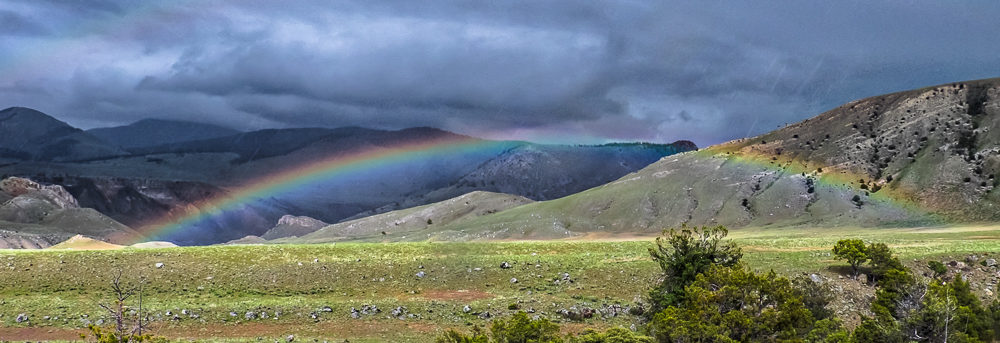
Beauty, Diversity, Partnerships Commingle at Ninepipe

We only have one day to explore Ninepipe National Wildlife Refuge. The weather is not too promising, but such is spring in Montana. Over the course of the day we may see sun, then rain, then sun, then clouds. An ever-changing landscape, but the birds are consistent. Waterfowl, songbirds, and raptors alike are nesting and beginning to raise their next generation.

We are 18 miles south of Flathead Lake, the largest natural freshwater lake west of the Mississippi in the lower 48 states, with over 200 square miles of water and 185 miles of shoreline. The refuge sits in the Mission Valley with the Mission Mountains east and the Salish Mountains west, but the center of our attention is the 1,672 acre lake in the middle of the refuge surrounded by many smaller ponds.

Entrance to Ninepipe is right across the road from the Lodge. You can see a bit of light above the grass line which is the lobby/restaurant entrance. Let’s explore a while before breakfast. It is a bit before 6am and the birds are calling as the sky brightens. Let’s see what surprises we find at sunrise!

Mission Mnts sunrise
So much to see . . .

Summer in the Rockies

Up, up, up into the mountains above Lamar Valley, with summer flowers and grasses waist-high. Walking poles become test devises for holes we can’t see in the lush foliage. Careful, there are holes deep enough to be up to your thigh with only one leg. Falling is always possible, but trusty poles help. These tripping dangers are the result of bison weight in the mud last spring, Uinta ground squirrels’ burrowing systems connecting their large community, and nature’s backhoe and rototiller, the badger, that digs holes up to 30 feet long and a foot in diameter. We will take our time, watch our step, and revel in the beauty of the hillsides that call us on.

mountain wildflowers

Sitting in the shade of the conifers, bit of marsh below, resting against a rock, we are cushioned by deep, soft needles. Decades of needles absorbing random noise. Horsetail plants thriving in the dampness of the marsh, tall grasses waving in the breeze. A nap is not out of order.

Slow down, stop talking, enjoy the wind, the rustling grasses, and bird song. Is that a stream we hear or the wind blowing though the conifers? A chipmunk scampering along a downed tree, a chickadee we hear but cannot see.  Flickers and Clark’s nutcrackers high in the trees adding their voices to the day’s chorus.

Aspens trembling in the breeze adding their black on white texture to the landscape. Sticky Geraniums presenting a symphony of pink. Indian Paintbrush popping scarlet staccatos. A crescendo of scattered white and yellow flowers. Always the conifers standing guard and keeping time. Take a deep breath, soak it in . . .

Welcome to summer in the Rockies!

Two Waterfalls, Two Miles–Glorious Yellowstone

Here we are, only four miles from Mammoth Hot Springs and we have two waterfalls in two miles. Ah, Yellowstone, with magnificent, pounding waterfalls along the Yellowstone River and these smaller yet glorious falls so close to the road. These two falls, Undine and Wraith, come from creeks flowing from mountains to the west. Undine Falls drops Lava Creek which continues about a mile flowing into the Gardiner River. The Gardiner continues an additional five miles ending as it flows into the Yellowstone River. Driving from Mammoth we pull in the first large parking area on the left. Walking down about 8 steps then ahead about 20 steps and here we are. This is so easy everyone must stop and enjoy again and again!

Undine Falls

One more falls . . .

SNAP*Shot: Mammoth’s Palette Spring Season After Season

Mammoth Terraces, including beautiful Palette Spring, is not the only reason to visit this area. Coming through Yellowstone’s North Entrance, we drive up almost 1,000 feet along five miles to Mammoth Hot Springs. This is the home of historic Fort Yellowstone, still the park’s administrative headquarters. The significant conservation policies developed here lead to establishing the National Park Service in 1916. From 1886 to 1918 the US Army administered the park, turning those duties over to the fledgling Park Service in 1918. Enjoy Yellowstone’s fascinating history by taking the virtual tour. Delight in the stories that gave us the world’s first National Park.

Today, though, we are driving by the Visitor’s Center, hotel, dining areas, gas station, and the only heated restroom along the Norther Tier road–you have no idea how welcomed that is in winter! Our destination is the massive rock mound call Mammoth Terraces. Palette Spring is the colorful introduction to Yellowstone’s unique hydrothermal area called Mammoth.

Wait a minute . . .